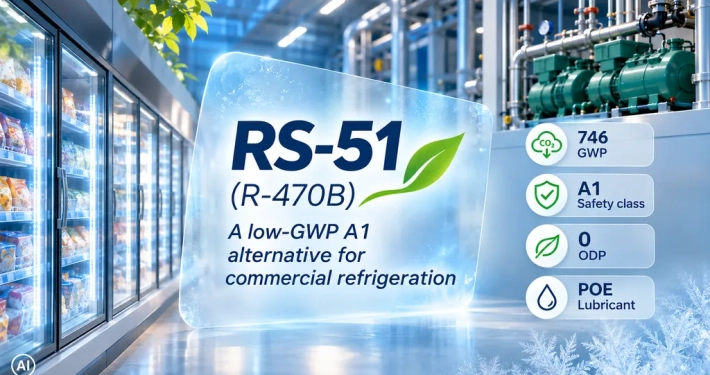
RS-51 (R-470B): a low-GWP A1 alternative for commercial refrigeration
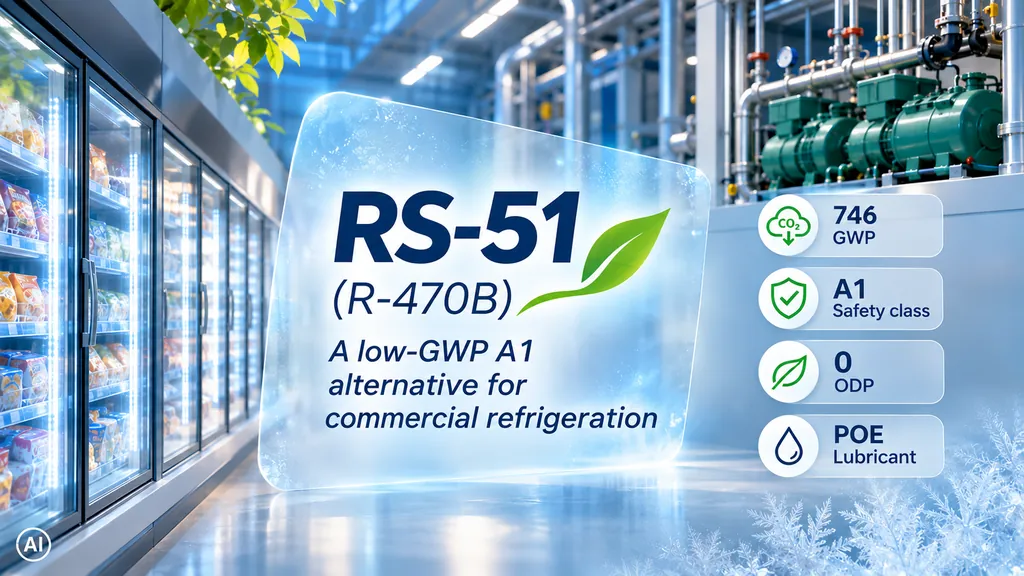
Product overview, real-world application and results of converting a supermarket frozen-food refrigeration rack previously operating with R-449A.
| 746 | A1 | 0 | POE |
| GWP | Safety | ODP | Lubricant |
Commercial refrigeration is undergoing a major transformation. Reducing the environmental impact of refrigerants is driving the industry to seek solutions that allow existing installations to evolve without compromising safety or the refrigeration performance required.
In this context, RS-51, the trade name of refrigerant R-470B, is presented as an alternative for commercial and industrial refrigeration installations. It is an HFC/HFO blend with a GWP of 746, ODP of 0 and A1 safety classification, compatible with POE lubricants.
Key data: GWP 746 · ODP 0 · A1 safety · Compatible with POE
What is RS-51 (R-470B)?
RS-51 is a refrigerant developed as a replacement for R-404A, R-507A, R-448A and R-449A for low-, medium- and high-temperature applications, offering cooling capacity and energy efficiency similar to other A1 alternatives to R-404A.
One of its main distinguishing features is its A1 safety classification combined with a GWP of 746, approximately 80% lower than that of R-404A and 45% lower than that of R-448A and R-449A.
These characteristics make RS-51 a particularly interesting option when the aim is to reduce GWP while retaining a solution within safety group A1.
From product to real-world application: replacing R-449A in a supermarket
Beyond the theoretical properties of the refrigerant, one of the key questions is how it performs in a real installation.
GRIT has applied RS-51 in a supermarket frozen-food refrigeration rack that previously operated with R-449A. The work was carried out as part of a store refurbishment and refrigerant change.
The rack has a stated refrigeration capacity of 22.25 kW and is equipped with three Bitzer semi-hermetic compressors, serving four different applications:
- Two frozen-food cold rooms.
- One frozen-food display island divided into three sections.
- One ice machine.
The installation also features a heat-recovery system on the discharge line to heat domestic hot water to approximately 70°C, as well as an economiser that uses evaporation of part of the condensed liquid to subcool the liquid line supplying the evaporators.
A conversion tailored to the installation’s requirements
The refrigerant change formed part of a broader intervention on the installation. The work carried out included:
- Installation of two additional suction separators.
- Oil replacement.
- Replacement of gaskets and components with a potential leakage risk.
- Replacement of solenoid valves and shut-off valves.
- Installation of new expansion valves.
- Increasing the diameter of various lines connected to the frozen-food display islands.
This demonstrates that a retrofit must be assessed in the context of the installation as a whole, taking into account the refrigerant’s characteristics, design, existing components and operating conditions.
How did RS-51 perform under real operating conditions?
Data recorded during commissioning make it possible to assess the installation’s performance after conversion.
The rack operated at an evaporation pressure of 0.45 bar and a condensation pressure of 17.0 bar. Evaporation temperatures recorded at the compressors ranged from −30.0°C to −26.4°C, while condensation temperatures ranged from 39.4°C to 40.8°C.
Temperatures recorded at the refrigerated services
| Service | Cabinet temperature |
| Island 6 | −25°C |
| Island 7 | −22°C |
| Island 8 | −22°C |
| Ice machine | −23°C |
Superheat values of 6.1 to 6.5 K were measured across the three display islands. These results show that the conditions provided by the rack enabled the supermarket’s different services to remain within the intended freezing range during commissioning tests.
Stability during defrost cycles
The four services were configured for two defrost cycles per day, terminating at 5°C, with a maximum duration of 45 minutes and a two-minute drain period. The actual heating times recorded ranged from 38 to 44 minutes.
During commissioning, a coordinated response was observed between the rack and the services. The intended freezing setpoints were achieved, while defrost cycles, superheat values and recorded auxiliary consumption remained balanced.
RS-51 in a real installation: stability and freezing performance
The case study shows how RS-51 can be integrated into a commercial freezing installation previously operating with R-449A. During commissioning, the rack and refrigerated services responded in a coordinated manner, with stable operation and temperatures consistent with freezing requirements.
At pressures of 0.45 bar for evaporation and 17.0 bar for condensation, the rack recorded evaporation temperatures between −30.0°C and −26.4°C. Condensation temperatures, between 39.4°C and 40.8°C, reflected consistent operating conditions across the compressors.
The most relevant result for the commercial application was achieved at the refrigerated services: −25°C at island 6, −22°C at islands 7 and 8, and −23°C at the ice machine. Island superheat values of 6.1 to 6.5 K, together with two daily defrost cycles per service and actual heating times of 38 to 44 minutes, provide a reference for balanced operation during the tests.
For owners, maintenance contractors and engineering firms, this experience provides real-world data for assessing RS-51 in retrofit projects and establishing an initial monitoring benchmark. The measurements support the performance observed during commissioning and will help identify deviations during operation; they do not replace the technical assessment of each installation or long-term performance monitoring.
Are you considering alternatives for an existing installation?
At GRIT, we work with refrigeration solutions designed to meet the industry’s current needs. Our activities include the manufacture, filling, marketing, storage and innovation of technical gases, together with the management of fluorinated-gas waste. GRIT holds ISO 9001 and ISO 14001 certifications and states that it complies with the AHRI 700 standard for new and recycled refrigerants.
Contact our team to discuss your installation’s characteristics and assess the most suitable solution.
■ Communication Team